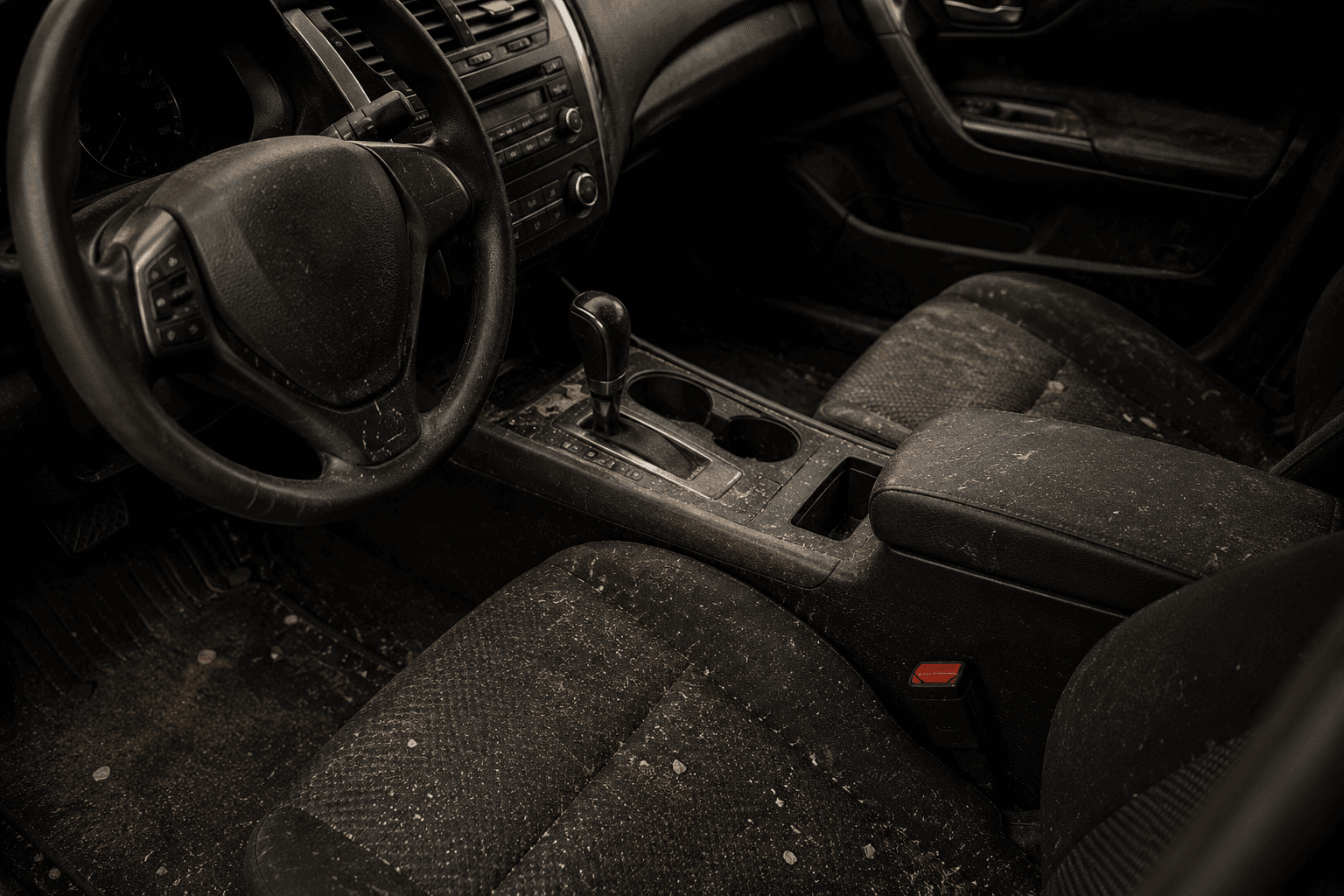
You spend, on average, one to two hours in your car every day. That's roughly 400 to 700 hours per year inside a space that's effectively a second room — and the psychological effects of that room follow the same rules as any other environment you occupy regularly. Your car is not exempt from environmental psychology.
What Clean Does to Your Brain
Research published in the Personality and Social Psychology Bulletin found that cleaner environments improve concentration and cognitive function. The effect isn't subtle: clutter and visual disorder in your peripheral vision create ongoing low-level cognitive load. That load accumulates invisibly over the course of a 45-minute commute.
Cortisol, the primary stress hormone, measurably increases in disordered environments. Visual complexity — even minor clutter — elevates baseline stress response. Your dirty car isn't just aesthetically unpleasant. It is, in a measurable sense, raising your stress level every single day you drive it.
Studies show clean environments measurably lower cortisol levels. The car you spend 400+ hours in per year is not exempt from this fundamental effect.
The Road Rage Connection
Drivers in disordered environments show reduced patience, increased irritability, and heightened reactivity to traffic frustrations. The connection between a cluttered interior and aggressive driving behavior has been documented in behavioral psychology research for over a decade. Most drivers assume road rage originates from other drivers. Often, the environment that primes the reaction begins inside the car before any external frustration occurs.
Broken Windows, Applied to Your Commute
The "broken windows theory" — originally applied to urban environments — holds that visible disorder invites more disorder. A crumpled receipt on the floor becomes three. A forgotten water bottle becomes six. The car that "just needs a quick clean" is the car that's been "just needing a quick clean" for two years.
Professional detailing resets that threshold completely — psychologically as much as physically. Once the interior is genuinely clean, the tolerance for disorder drops sharply. The car stays cleaner longer simply because the psychological baseline has been reset.
The Pride Effect
There's a well-documented behavioral shift that occurs after a professional detail. Owners drive more carefully. They remove items before they accumulate. They're more likely to maintain the clean state over time. Psychologists call this the "pride effect" — the tendency to maintain things we perceive as having current value.
First Impressions in a Moving Room
Passengers, clients, first dates — everyone who enters your car forms an immediate impression. The interior signals the same things a living room signals: care, taste, and attention to the things that belong to you. That impression is formed in seconds and almost impossible to revise after the fact.
You're not just cleaning your car. You're clearing your head, signaling your standards, and protecting your first impression. The detail pays for itself three ways at once. Book a mobile detail near you and reset the baseline.