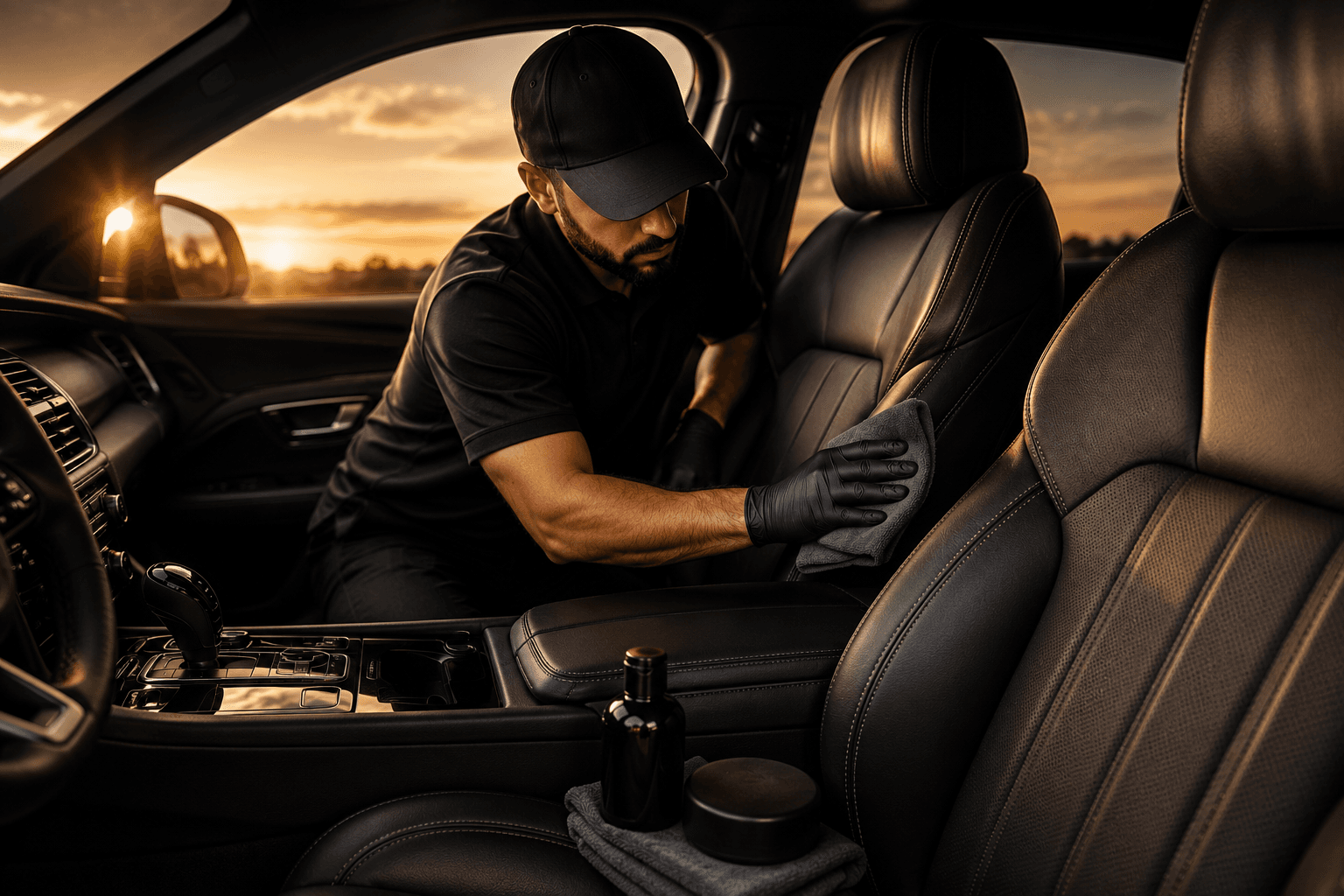
Leather seats are the most maintenance-intensive surface in your vehicle — and the most unforgiving. The damage accumulates silently, invisibly, until one day you sit down and hear the faint creak of upholstery that's been drying out for years without anyone noticing.
The Enemy You Can't See
UV radiation is leather's primary adversary. Every hour your car sits in sunlight, ultraviolet rays penetrate the surface and attack the collagen structure that keeps leather supple. The process is gradual enough to be invisible until the first crack appears. By the time that crack forms, the surrounding leather has already lost a significant percentage of its natural moisture content.
Most owners don't apply UV protectant to their leather at all. Of those who do, most apply it too late — after visible fading has already begun and the protective window has partially closed.
The Mistake Most Owners Make
The typical leather care approach: ignore it completely until it looks visibly worn, then apply a conditioning product and hope for improvement. This is entirely backwards. Conditioning works as prevention. Once leather has dried out enough to crack, conditioning can restore some moisture — but it cannot close a crack that has already formed. That requires physical repair or full reupholstering.
The correct conditioning schedule is every 2–3 months — not when leather already looks dry. By that point, the micro-damage has already been done and is irreversible.
What You're Using Is Probably Wrong
Household cleaners — including multi-surface wipes, ammonia-based sprays, and bleach solutions — strip the natural oils from leather on contact. A single wipe with an ammonia cleaner does more damage than months of normal use. The leather looks clean immediately after, but the protective oils that give it flexibility have been removed entirely.
Over time, this creates a damaging cycle: clean with the wrong product, leather dries faster, condition more frequently to compensate, strip more oils in the next cleaning. The end result is leather that deteriorates twice as fast as it should under normal wear.
The Correct Schedule
Light cleaning with a pH-balanced leather cleaner every two to four weeks. Conditioning every two to three months. UV protectant applied at the start of each summer. This isn't excessive — it's the minimum required to prevent the kind of damage that costs real money to fix later.
What Professional Detailers Do Differently
Professional leather care uses pH-balanced cleaners that match the chemistry of tanned hide. Conditioner is worked in with proper applicators to ensure penetration rather than surface coating. For vehicles with significant sun exposure, nano-ceramic coating provides a semi-permanent UV barrier that extends the functional life of the leather substantially.
The Cost Comparison
Professional leather reconditioning as part of a full detail: $150 to $250. Reupholstering a front seat in matching leather: $500 to $1,500 minimum. A full interior reupholstery job on a premium vehicle: upward of $3,000.
Your leather seats have one shot at looking great. That window is open right now. Once the cracks form, you're negotiating with permanent damage. Don't wait until you're there. Have questions about what's included? Check our FAQ or find a mobile detail in your area.